

Global trade today is passing through one of its most uncertain phases. The ongoing West Asia crisis has added layers of complexity to an already fragile environment, with supply chains being rerouted, logistics costs fluctuating, and exporters facing heightened risk exposure across key corridors. Yet amid this disruption, one fact stands out clearly—India is not leaving its exporters to navigate this storm alone.
What we are witnessing is not routine policy intervention. It is targeted, situation-driven support, designed around real challenges faced by exporters. Through continuous engagement with the industry, ESC is seeing how these measures are not just announcements—they are actively helping businesses sustain momentum, protect margins, and in many cases, move faster than competitors.
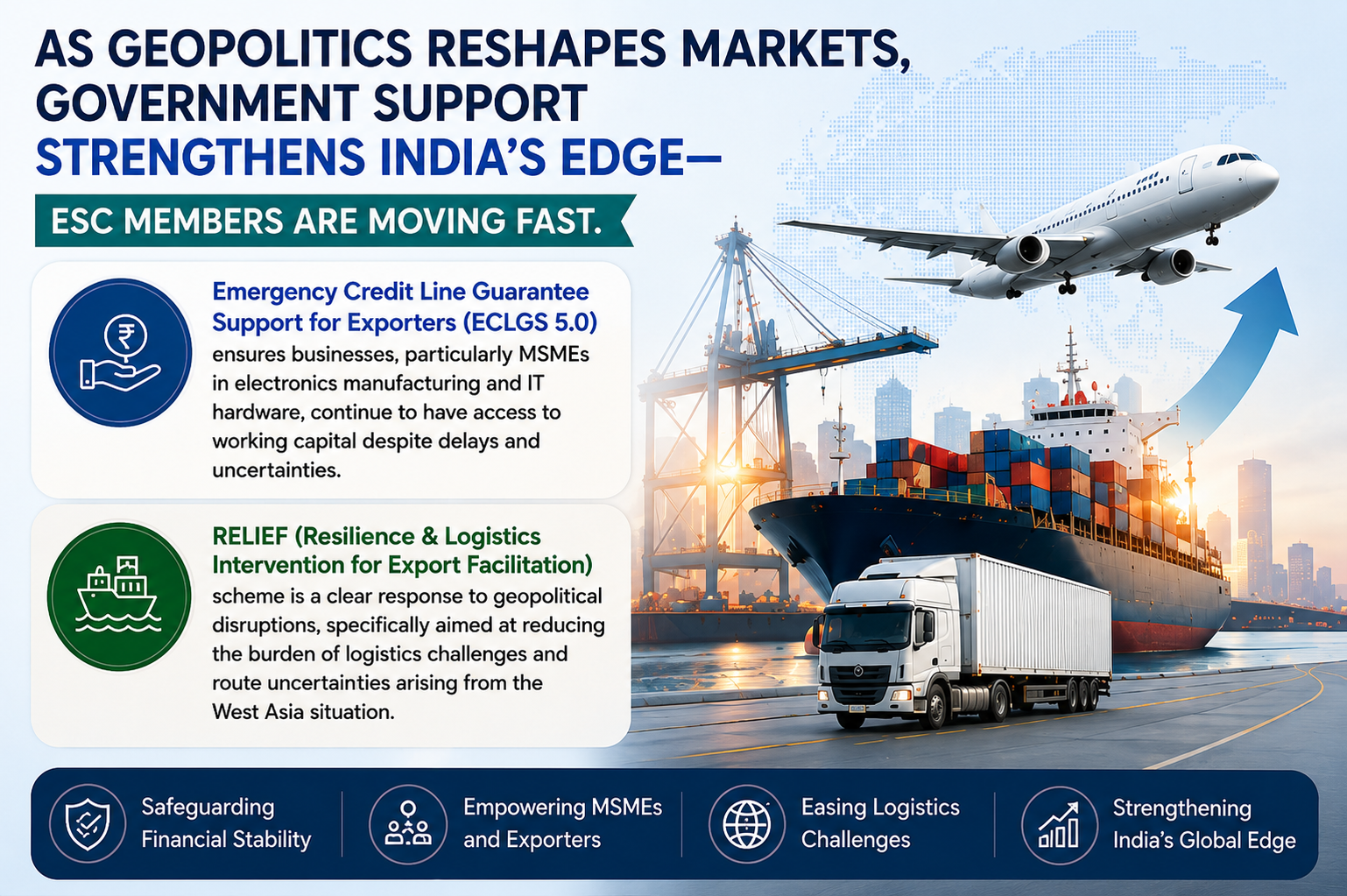
Take the Emergency Credit Guarantee Scheme for Exporters, with an estimated support size of around $1.9 billion. For many MSME exporters in electronics and IT hardware, working capital has always been the first pressure point during disruptions. Delayed payments, rising freight costs, and extended cash cycles can slow down even the most capable businesses. What this scheme has done is remove that bottleneck. ESC members are not just using it as a safety net—they are using it to keep production running, fulfil orders on time, and avoid losing market share while others hesitate.
At the same time, the extension of Export Insurance Support for High-Risk Routes, especially across the Gulf region, has addressed one of the biggest concerns in the current scenario—risk exposure. With critical routes like the Strait of Hormuz facing uncertainty, exporters could have easily pulled back. Instead, what we are seeing among ESC members is the opposite. With insurance coverage in place, they are continuing shipments, maintaining buyer commitments, and reinforcing trust in international markets—at a time when reliability itself has become a competitive advantage.
A particularly sharp intervention has come through the RELIEF Scheme (Resilience & Logistics Intervention for Export Facilitation) introduced by DGFT. This is not a broad policy—it is a precision response to disruption, focusing on logistics cost pressures, route uncertainties, and time-bound support. For electronics exporters operating within tightly connected global supply chains, this has made a tangible difference. ESC members dependent on West Asia routes are already reworking logistics strategies, securing alternative pathways, and ensuring continuity, instead of waiting for stability to return.
On the operational front, the CBIC relaxation measures under force majeure conditions have quietly delivered one of the most impactful forms of support—flexibility. Whether it is simplifying re-routing procedures, waiving amendment fees, or enabling faster handling of disrupted shipments, these measures have reduced friction at a critical time. The difference is visible. While many exporters struggle with procedural delays during disruptions, ESC members are able to adapt quickly, move shipments efficiently, and keep their commitments intact.
Another strategic relief has come through the temporary flexibility extended to Special Economic Zone (SEZ) units, allowing domestic sales at reduced duties. In a volatile demand environment, inventory can quickly become a liability. This measure has given electronics manufacturers the ability to rebalance. ESC members are already using this flexibility to manage excess stock, maintain cash flow, and keep production cycles stable, rather than slowing down operations.
What stands out across all these measures is a clear pattern—the government is reducing risk, but exporters still need to act on opportunity. This is where a visible gap is emerging in the market. Awareness of schemes is widespread, but execution is not.
ESC members are increasingly on the right side of this gap. They are not just informed—they are interpreting policy quickly, aligning business decisions, and converting support into action. Whether it is sustaining exports in high-risk regions, adjusting supply chains, or leveraging financial and operational relief, they are moving with clarity while others are still evaluating.
And that is where the real difference lies today. Being informed is good, but being connected is what truly makes the difference.
Conclusion
The current global situation is testing exporters—but it is also creating a new kind of advantage. With responsive government support in place, the foundation is stronger than ever. The real question is not whether the support exists, but who is ready to act on it.
ESC members are already demonstrating that when policy insight meets timely action, disruption can be turned into momentum. And for those still watching from the sidelines, the shift is becoming clear—in today’s export landscape, having the right bridge between government support and business execution is no longer optional, it is decisive.

Electronics and Computer Software Export Promotion Council of India (ESC), one of India’s most dynamic premier trade promotion organisations sponsored by the Government of India.
Copyright @ Electronics and Computer Software Export Promotion Council
