

From Dependence to Depth: India’s Electronics Roadmap
There are some numbers you don’t just read—you sit with them. For the Electronics and Computer Software Export Promotion Council (ESC), one such number stands out: $132 billion—the value of goods India imported from China in FY26.
At first glance, it appears to be just another trade statistic. But in reality, it is a mirror. A mirror reflecting both India’s strengths and its gaps.
A deeper look reveals something far more significant. Over $75 billion of these imports are not finished consumer goods, but components, machinery, and electronics—the essential building blocks that quietly power India’s manufacturing and export ecosystem.
As one exporter put it, “We don’t import because we want to. We import because we have to keep moving.”
This dependence, therefore, is not a reflection of weakness. It is a signal of transition—one that points directly to where India must now build depth.
Understanding the Shift
India’s electronics sector has made remarkable progress over the past decade, particularly in scaling assembly-led manufacturing and expanding exports. However, the data highlights a structural reality: while India has strengthened its position as a manufacturing base, significant reliance on imported inputs continues to underpin this growth.
This is not unusual for an economy in transition. In fact, such dependency often accompanies phases of rapid industrial expansion. What matters is how this moment is leveraged.
The global electronics supply chain is no longer reorganising primarily on the logic of cost. It is reorganising on the logic of trust. The US CHIPS Act, the EU Chips Act, Japan’s semiconductor subsidies, and the broader technology decoupling between the US and China have created a structural demand for a third category of manufacturing partner, one that is large, capable, democratic, and not entangled in great-power competition. India is, at this moment, the only economy that meaningfully fits that description at scale.
From ESC’s perspective, the current landscape presents a clear direction. The focus must now shift from scale alone to capability—moving beyond assembly toward deeper value addition across the electronics value chain.
The roadmap: From Dependence to Depth
This transition must be approached in a structured and phased manner.
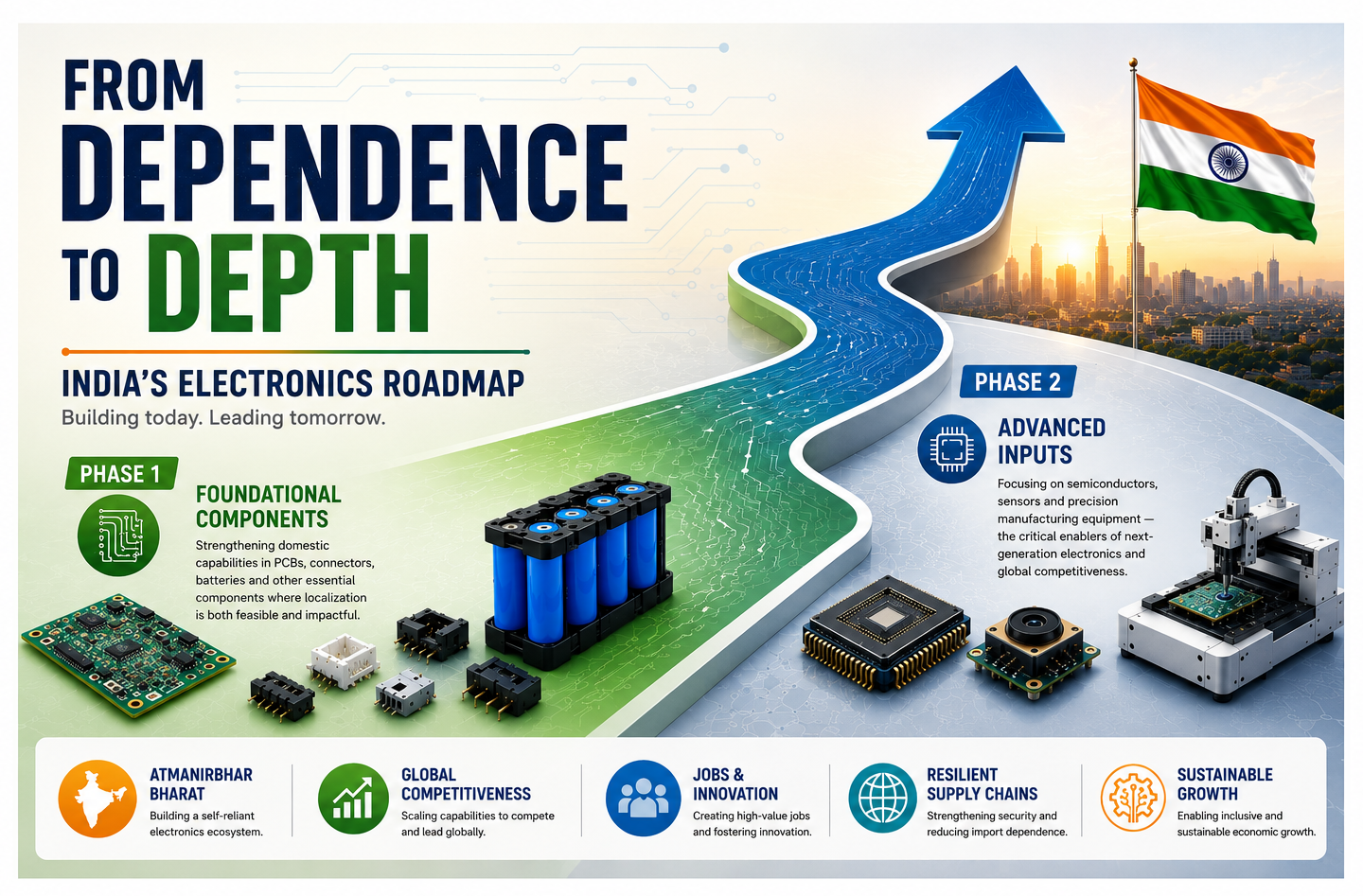
The first step lies in strengthening domestic capabilities in foundational components—such as printed circuit boards, connectors, and batteries—where dependence remains high but localization is both feasible and impactful.
Building on this, the next phase must focus on developing advanced inputs, including semiconductors, sensors, and precision manufacturing equipment. These are the critical enablers of next-generation electronics and the stages of the Global Value Chain (GVC) where switching costs are highest and strategic leverage is greatest
Ultimately, the journey must lead toward a design-led ecosystem—one where India not only manufactures, but innovates. This includes strengthening R&D capabilities, fostering intellectual property creation, and building globally competitive product development ecosystems anchored in India. The goal is not to replicate what Taiwan or South Korea built, but it is to build something suited to India’s specific strengths: software fluency, systems engineering talent, and a domestic market large enough to absorb risk.
Enabling the Transition
Achieving this shift will require a coordinated and sustained effort across multiple fronts.
Policy frameworks such as Production Linked Incentive (PLI) schemes have played an important catalytic role. However, the first generation of PLI was calibrated for the wrong outcome metric. It incentivised output volume rather than value-add depth. The result: electronics PLI successfully scaled smartphone assembly, but the share of value genuinely captured within India across design, components, and tooling remained low. A second-generation PLI must be restructured around localisation ratios and technology transfer milestones, not just production targets. The distinction matters enormously for long-term competitiveness. The semiconductor mission, Make in India, and the broader ecosystem of industrial incentives provide a strong directional foundation. Their long-term impact will depend on how effectively they are aligned with the specific segments of the electronics value chain where India’s import dependence is highest and where global buyers are most actively seeking alternatives.
Equally important is the role of industry-academia collaboration. Joint research initiatives, innovation hubs, and knowledge partnerships will be essential to accelerate capability-building.
Targeted investments in advanced materials, precision engineering, and electronics design must also be prioritized. At the same time, building a future-ready talent pipeline—skilled in semiconductor design, robotics, and AI hardware—will be critical to sustaining momentum.
The Standards Dimension
There is one element of GVC leadership that rarely features in manufacturing roadmaps but is decisive in practice: the power to set standards.
Economies that are true pillars of global value chains do not merely comply with standards set elsewhere; they participate in defining them. BIS, STQC, and India’s emerging frameworks for electronics product safety, cybersecurity compliance, and connected device certification are not just regulatory instruments. They are the infrastructure of trust that global buyers require before they commit supply chain depth to any geography.
As India positions itself as a long-term manufacturing partner for markets in Europe, North America, and the Indo-Pacific, the ability to demonstrate standards equivalence, and eventually standards influence, will be as important as cost competitiveness. This is a dimension where ESC’s convening role across industry, regulators, and international bodies becomes directly strategic.
India’s Global Positioning
Global supply chains are undergoing a structural realignment. Businesses and economies are actively seeking diversified and resilient sourcing bases.
India’s opportunity lies not in replacing one dependency with another, but in positioning itself as a trusted and indispensable node within this evolving landscape.
Stronger domestic supply chains will not only reduce costs and improve lead times, but also enhance confidence among global buyers. This, in turn, will enable Indian exporters to compete on reliability, speed, and integrated capabilities—not just price.
The objective is clear: to evolve from being a participant in global value chains to becoming a pillar within them.
The Way Forward
From ESC’s perspective, this moment represents more than a trade imbalance—it represents a strategic inflection point.
The path forward lies in aligning policy, industry, investment, and talent toward building scale, capability, and technological depth. It calls for looking beyond immediate trade flows and engaging with the larger structural transformation underway.
Because the true significance of this data is not in the dependence it reflects—but in the opportunity it presents.
Dependence, in this context, is not a weakness—it is a signal. It highlights where India must build, invest, and innovate.
The future of India’s electronics sector will not be defined by how quickly imports decline, but by how deeply domestic capabilities are created, how strategically trade frameworks are shaped, and how deliberately India positions itself within a global supply chain order that is being rewritten in real time.
From dependence to depth, and from participation to leadership—this is the pathway that will shape India’s place in global value chains, and define the next chapter of its electronics export journey.
Source: Ministry of Commerce and Industry (DGCIS/DGFT), Government of India; ESC analysis

Electronics and Computer Software Export Promotion Council of India (ESC), one of India’s most dynamic premier trade promotion organisations sponsored by the Government of India.
Copyright @ Electronics and Computer Software Export Promotion Council
