

Powering India’s Semiconductor Future: From Policy Momentum to Execution Excellence
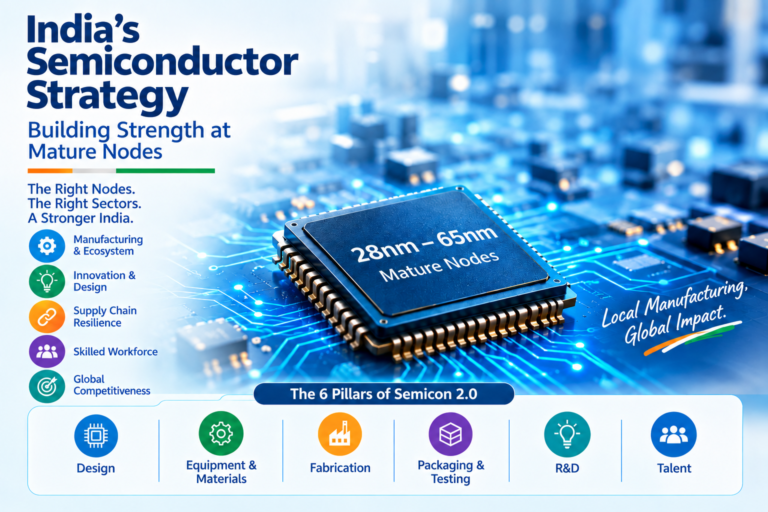
India’s semiconductor story just entered its most decisive chapter yet. With Semicon 2.0 now approved by the Union Cabinet — backed by an outlay of ₹1.27 lakh crore (~USD 13.3 billion) — the country isn’t just building chip factories anymore. It’s building an entire ecosystem: design, packaging, equipment manufacturing, specialty materials, R&D, and talent, all in one integrated push.
For an industry that has spent decades watching semiconductor manufacturing happen everywhere except India, this is the moment the ground genuinely shifts.
What Makes Semicon 2.0 Different
The first phase of the India Semiconductor Mission proved India could attract fabs and packaging units. Semicon 2.0 goes several steps further — extending the programme’s lifecycle from 5 years to 12, a signal that this isn’t a short-term subsidy push but a long-horizon industrial commitment designed to give investors the confidence a fab actually needs before its first chip rolls off the line.
The mission now spans the full value chain — chip design, advanced packaging, semiconductor-grade equipment, specialty materials, and workforce development — rather than fabrication alone. It builds on real momentum: several projects are already commercially producing chips, dozens of design projects have been cleared under the Design Linked Incentive Scheme, and over a hundred startups and MSMEs now have access to industry-grade chip design tools.
In short — India is positioning itself as a trusted and resilient partner in the global semiconductor supply chain.
The Numbers Behind the Momentum
This policy push isn’t happening in isolation — it’s riding a genuine export boom. Electronics has emerged as India’s second-largest merchandise export category, overtaking petroleum products during the recent export period, with electronic goods exports growing 18.9% year-on-year in June 2026 alone. Between April and June 2026, exports touched USD 15.19 billion, a 22.1% jump over the same period last year.
Smartphones remain the single largest contributor to this growth — but increasingly, the real story is broader: components, hardware, telecom equipment, and now, semiconductors themselves are becoming meaningful pillars of India’s electronics export basket. Semicon 2.0 is designed precisely to accelerate that shift, from assembling electronics to manufacturing the chips inside them.
What This Means for Business — Operational Lessons for the Sector
Policy tailwinds are only half the story. Recent industry analysis of the semiconductor business highlights that the sector is entering a phase where operational discipline will matter as much as market opportunity.
A few takeaways worth every semiconductor and electronics business owner’s attention:
Margins are under pressure, even amid growth. Even as top-line revenue targets are being met across the sector, gross margins are compressing — largely due to rising variable overheads and the cost of maintaining legacy infrastructure. Growth alone isn’t a guarantee of profitability; cost architecture matters just as much.
Digital-first models are outgrowing their own infrastructure. Companies leaning into digital-first pipelines are hitting capacity constraints — a sign that demand is outpacing the systems built to serve it. Meanwhile, traditional distribution channels, especially in mid-tier regions, continue to carry high fixed costs and slower fulfilment cycles, dragging down overall efficiency.
The way forward is flexibility, not just scale. The clearest recommendation emerging from this analysis is a shift from rigid, fixed-cost operating models to flexible, variable-cost structures — including smarter use of strategic outsourcing — to protect margins as the business scales. Alongside this, companies are being urged to modernize core digital infrastructure, eliminate data silos, and build real-time visibility into performance through automated reporting, rather than reacting to problems after the fact.
The message is clear: The semiconductor opportunity is not just about participating in global value chains—it is about shaping them.
Where ESC Comes In
This is exactly the moment where an industry body’s role becomes indispensable — not as a passive observer, but as an active enabler.
As India’s apex trade promotion body for electronics, IT, and ITeS exports, ESC is uniquely positioned to help members navigate this transition — from policy interpretation and market access, to building the right global partnerships and positioning Indian semiconductor and electronics businesses for the opportunities Semicon 2.0 is unlocking.
Whether it’s connecting members to relevant government schemes, curating B2B engagements with global buyers actively seeking supply chain diversification, or providing the market intelligence needed to make smarter operational decisions — ESC’s role is to ensure that Indian electronics and semiconductor businesses don’t just participate in this growth story, but lead it.
The opportunity in front of India’s electronics and semiconductor ecosystem is once-in-a-generation. The businesses that move early — with the right partnerships, the right operational discipline, and the right industry backing — will be the ones defining India’s chip future.
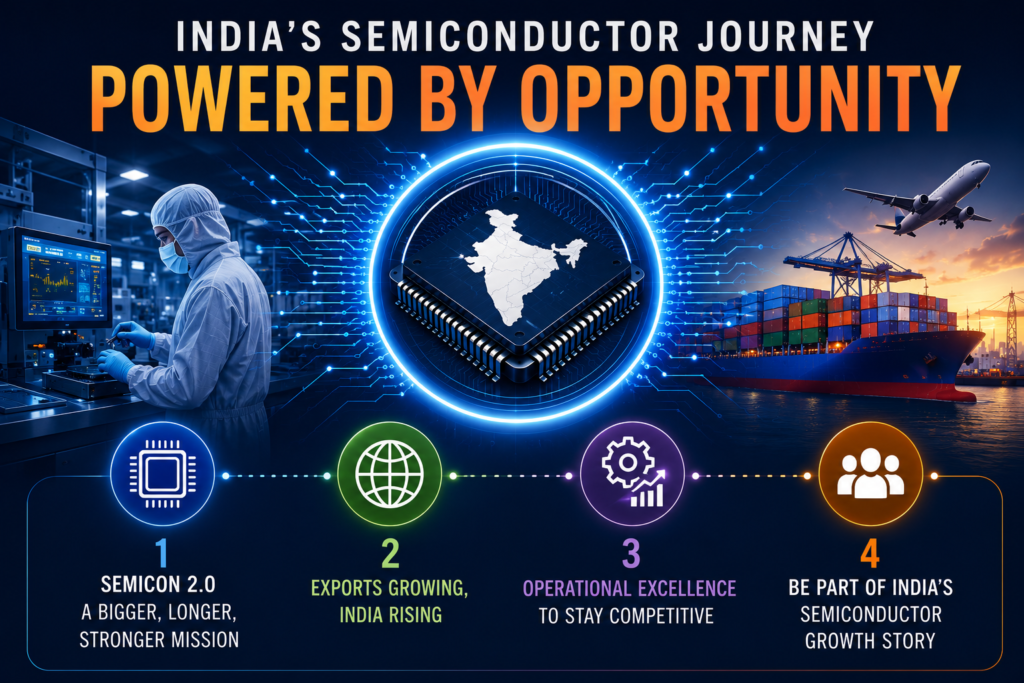
Be Part of India’s Semiconductor Growth Story
If you’re an electronics manufacturer, semiconductor company, or technology exporter looking to make the most of Semicon 2.0 and India’s expanding export momentum, now is the time to align with the ecosystem driving this change.
Explore ESC membership and discover how we can help you scale globally, navigate policy, and build the right partnerships for what comes next.

Electronics and Computer Software Export Promotion Council of India (ESC), one of India’s most dynamic premier trade promotion organisations sponsored by the Government of India.
Copyright @ Electronics and Computer Software Export Promotion Council