

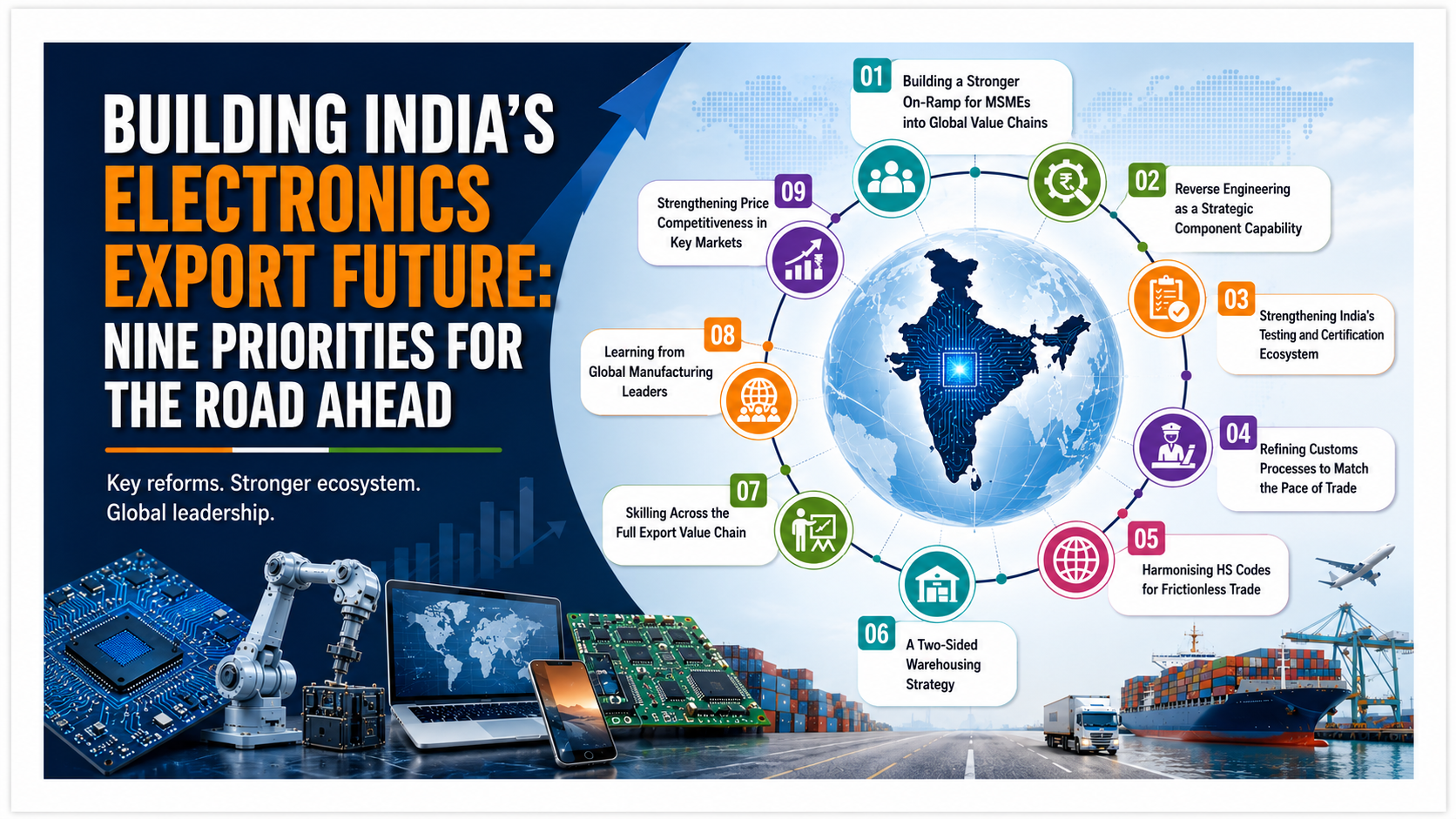
Building India’s Electronics Export Future: Nine Priorities for the Road Ahead
India’s electronics export ambition—$150 billion by 2030—is not just a target; it is a test of execution. While the headline number captures attention, the real story lies in the precision, coordination, and policy depth required to achieve it. With electronics exports already crossing significant milestones in recent years, the next phase of growth will depend less on intent and more on how effectively the underlying ecosystem is strengthened.
At ESC India, the focus has consistently been on translating national ambition into actionable, sector-level direction. Drawing on recent industry deliberations, here are nine priorities that carry real potential to accelerate India’s electronics export trajectory.
1. Building a Stronger On-Ramp for MSMEs into Global Value Chains
Global electronics trade is anchored in deeply integrated value chains. For sustainable scale, MSMEs need to evolve beyond domestic supply roles and become qualified partners to global OEMs. A dedicated, PLI-aligned framework tailored for MSMEs can support this transition—helping them meet global standards, integrate into supply chains, and unlock export-led growth. Having built scale at the top, the next opportunity lies in strengthening the base.
2. Reverse Engineering as a Strategic Component Capability
Developing domestic reverse-engineering capabilities is emerging as a forward-looking strategy to deepen the component ecosystem. This is not about replication, but about building design intelligence, reducing long-term import dependence, and strengthening indigenous manufacturing depth. Over time, this can become a critical lever for both cost competitiveness and technological resilience.
3. Strengthening India’s Testing and Certification Ecosystem
As exports expand, so does the need for globally recognised testing and certification infrastructure. Scaling such capabilities domestically can significantly reduce turnaround times, lower costs, and minimise dependence on overseas labs. More importantly, it positions India as a credible and self-reliant quality-assurance hub within global supply chains.
4. Refining Customs Processes to Match the Pace of Trade
Electronics trade today operates at speed—and customs systems must keep pace. Incremental yet impactful refinements can make a measurable difference: better alignment of import-export tariffs, flexible timelines for exhibition goods, and streamlined provisions for repair imports. These operational improvements, though technical, directly enhance ease of doing business and exporter competitiveness.
5. Harmonising HS Codes for Frictionless Trade
Accurate product classification is the backbone of efficient exports. Continued harmonisation of HS codes with evolving product categories—supported by closer coordination between industry and Customs—offers a high-impact, low-disruption opportunity. It simplifies compliance, reduces ambiguity, and improves transaction efficiency for exporters.
6. A Two-Sided Warehousing Strategy
Supply chain agility is increasingly defining export success. Domestically, bonded warehousing for component suppliers can shorten lead times and improve responsiveness. Internationally, establishing warehousing hubs in strategically located markets can bring products closer to buyers, reducing delivery timelines and strengthening price competitiveness.
7. Skilling Across the Full Export Value Chain
The electronics export ecosystem requires talent at every level—from shop-floor technicians to export strategists. A dual-focus skilling approach is essential: hands-on manufacturing training to strengthen production capabilities, alongside specialised programs to develop export professionals skilled in compliance, documentation, and global market dynamics. Strong manufacturing must be matched by equally strong export execution.
8. Learning from Global Manufacturing Leaders
As competition for global value chains intensifies, continuous benchmarking against leading manufacturing economies becomes critical. The focus lies in adapting best practices in incentives, infrastructure, and ease of doing business—ensuring the policy framework remains globally competitive and future-ready.
9. Strengthening Price Competitiveness in Key Markets
Exchange rate movements are a natural part of global trade, and current currency dynamics offer exporters a favourable pricing position in select overseas markets, including the United States. Rather than viewing this as a short-term advantage, the opportunity lies in using this window to deepen long-term relationships with global buyers, strengthen reliability as a supply partner, and convert near-term competitiveness into durable market share. A stable, forward-looking approach to market expansion—one that outlasts any single currency cycle—is what will ultimately define positioning in these markets over the long run.
The Common Thread: Execution at Scale
What connects these priorities is their practicality. None require a reinvention of strategy—they call for sharper execution of an already well-aligned roadmap. The real opportunity lies in disciplined follow-through: building infrastructure, refining systems, and strengthening capabilities step by step.
India’s electronics export journey is no longer about discovering direction—it is about accelerating delivery. Every testing lab commissioned, every MSME integrated into a value chain, and every export professional trained adds momentum to the larger goal.
The $150 billion milestone will not be achieved through a single breakthrough, but through consistent, coordinated progress across the ecosystem.
As the authorised voice for electronics and IT/ITeS exports, ESC India remains committed to tracking these shifts, enabling industry alignment, and ensuring that India’s export story continues to move from ambition to global leadership.

Electronics and Computer Software Export Promotion Council of India (ESC), one of India’s most dynamic premier trade promotion organisations sponsored by the Government of India.
Copyright @ Electronics and Computer Software Export Promotion Council
