
India’s Electronics Exports: A Shift Beyond Smartphones
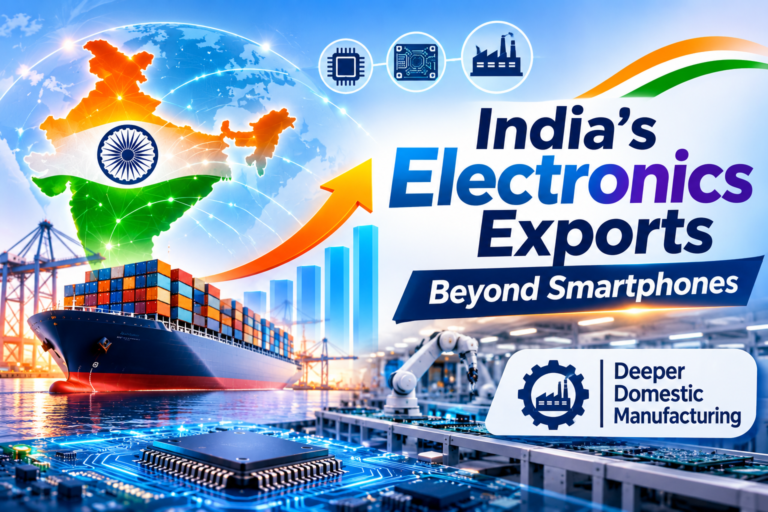
India’s electronics exports are witnessing a significant expansion, with growing momentum across product categories beyond smartphones. According to the Ministry of Commerce & Industry, electronic goods exports increased by 44% year-on-year to US$31.97 billion during April–September FY 2026–27, compared with US$22.20 billion in the corresponding period of the previous financial year.
While smartphone exports grew by 35.8% to US$18.17 billion, non-smartphone electronics exports registered a faster growth of 56.5%, reaching US$13.79 billion. Consequently, the share of non-smartphone products in total electronics exports increased from 39.7% to 43.2%, signalling a gradual diversification of India’s electronics export basket.
Table 1: India’s Electronic Goods Exports – Smartphone vs Non-Smartphone
Indicator | April–September FY26 | April–September FY27 | Growth |
Total electronic goods | $22.20 Bn | $31.97 Bn | 44.0% |
Smartphone exports | $13.38 Bn | $18.17 Bn | 35.8% |
Non-smartphone exports | $8.81 Bn | $13.79 Bn | 56.5% |
Non-smartphone share | 39.7% | 43.2% | +3.5 pp |
Emerging Electronics Products Driving Export Growth
Beyond smartphones, several electronics product categories have registered exceptional export growth. Printed circuit boards, network transmission equipment, memory integrated circuits and solid-state storage devices have emerged as important contributors to the expansion of India’s electronics exports.
Table 2: HS-Code-Wise Export Performance of Emerging Electronics Products
April–September FY 2025–26 vs April–September FY 2026–27
HS Code | Product description | FY26 exports (US$ Mn) | FY27 exports (US$ Mn) | Growth |
84733030 | Parts and accessories comprising mounted PCBs | 63.3 | 2,100.0 | 3,219% |
85177910 | Populated, loaded or stuffed PCBs | 213.7 | 864.1 | 304% |
85176290 | Network transmission and routing equipment | 732.9 | 1,450.0 | 98% |
85423200 | Memory integrated circuits | 23.1 | 562.4 | 2,333% |
85235100 | Solid-state non-volatile storage devices | 14.6 | 260.5 | 1,680% |
The figures highlight the growing importance of PCBA-related products in India’s export basket. Exports under HS 84733030 increased by approximately US$2.04 billion, accounting for around 41% of the total increase in non-smartphone electronics exports during the period.
Memory integrated circuits and solid-state storage devices also recorded substantial growth, indicating emerging opportunities in semiconductor-related products and storage technologies. Meanwhile, network transmission and routing equipment exports reached US$1.45 billion, reflecting growing participation in global communication and data infrastructure supply chains.
Major Export Destinations: Market-Wise Performance
The expansion across emerging electronics categories has also been accompanied by growing exports to key international markets. Singapore, China, Hong Kong and Malaysia have emerged as important destinations across these product segments.
Table 3: Leading Export Destinations for Emerging Electronics Products
April–September FY 2026–27
Product category | HS Code | Leading destination | Export value (US$ Mn) |
Mounted PCB-related products | 84733030 | Singapore | 1,870.0 |
Populated PCBs | 85177910 | China | 789.2 |
Network transmission and routing equipment | 85176290 | Hong Kong | 857.7 |
Memory integrated circuits | 85423200 | Malaysia | 390.8 |
Solid-state storage devices | 85235100 | China | 108.6 |
The destination-wise distribution reveals significant market concentration in certain product categories. Singapore accounted for nearly 89% of exports under HS 84733030, while China accounted for approximately 91% of populated PCB exports. Similarly, Malaysia emerged as the largest destination for memory integrated circuits.
While these developments demonstrate India’s growing integration into international electronics supply chains, the concentration of exports in a limited number of destinations highlights the importance of market diversification and strengthening long-term trade relationships.
PCBA Exports: An Emerging Opportunity for Domestic Manufacturing
The sharp increase in exports of mounted and populated PCBs highlights an emerging opportunity for India to strengthen its position in the global electronics manufacturing value chain. These components are critical to computer hardware, telecommunications, networking equipment and several other electronic applications.
However, the growth in PCBA-related exports must also be assessed in the context of domestic manufacturing capabilities, imported input dependence and the extent of domestic value addition. Higher export volumes alone do not necessarily indicate the development of a strong indigenous component ecosystem.
Moving beyond assembly-led growth towards deeper manufacturing capabilities will require strengthening upstream segments, including bare PCB manufacturing, specialised materials, copper-clad laminates and production equipment. This would help India capture a greater share of value across the electronics supply chain.
ECMS: Strengthening Domestic Manufacturing Capabilities
The Electronics Components Manufacturing Scheme (ECMS) provides an important policy framework to strengthen India’s domestic electronics component ecosystem. The scheme supports manufacturing across multilayer PCBs, high-density interconnect (HDI) and flexible PCBs, upstream materials and capital equipment.
Government approvals have included PCBA manufacturing applicants, alongside subsequent approvals for multilayer PCBs and copper foil. The additional 1% turnover-linked incentive for eligible domestic sourcing or manufacturing of laminates used in multilayer PCBs further encourages the development of domestic supply chains.
These interventions can help reduce dependence on imported inputs, strengthen domestic component manufacturing and support higher-value electronics production.
Policy Priorities and the Way Forward
Sustaining India’s electronics export momentum will require translating rising export demand into higher domestic value addition, stronger upstream capabilities and deeper supply-chain integration. Three areas merit particular attention:
India’s recent electronics export performance signals a promising shift towards a more diversified export basket. However, sustaining this momentum will depend on the country’s ability to translate export growth into higher domestic value addition, stronger component manufacturing capabilities and deeper integration into global supply chains.
ESC’s research publication, India’s PCBA Export Opportunity: Scaling Value-Added Electronics Manufacturing Export, provides a more detailed assessment of India’s PCBA export potential, manufacturing competitiveness and opportunities for strengthening domestic capabilities.

Electronics and Computer Software Export Promotion Council of India (ESC), one of India’s most dynamic premier trade promotion organisations sponsored by the Government of India.
Copyright @ Electronics and Computer Software Export Promotion Council